Providers
TRELLIS.2 on your own GPU, Meshy and Tripo hosted.
| TRELLIS.2 (local) | Meshy | Tripo | |
|---|---|---|---|
| Runs | Your GPU, or one you rent | Hosted | Hosted |
| Cost | Free beyond hardware | Metered, your own key | Metered, your own key |
| Seed | Yes — a definition is a recipe | — | — |
| Input | One image only | Text or images | Text, image, or up to four views |
| Licence tier | Free, closed source | Free, closed source | Free, closed source |
TRELLIS.2 — local and reproducible
Microsoft's TRELLIS.2 in Docker on your own GPU or a rented one. Turns a single reference image into a textured PBR mesh, costs nothing beyond hardware, and honours a seed.
Code and weights are MIT licensed, with one real asterisk.
It conditions on a gated model. TRELLIS.2 needs
facebook/dinov3-vitl16-pretrain-lvd1689m, which is gated under Meta's
licence and requires manual approval before anything can generate.
Worse, that grant does not currently appear on the Keys page — no mesh provider declares a key-access requirement, so the page shows the shared Hugging Face key without the grant it needs. This is a known gap. Request access at the model's Hugging Face page; approval can take days.
One image, and it says so
It generates from one image and nothing else — no text prompt, no multiple images. MeshForge reports this as a capability, so a prompt-only definition is refused with a sentence rather than a schema error.
No mesh pipeline class
TRELLIS has no mesh pipeline of its own. A definition reaches it through its Provider Id (Mesh ▸ Advanced, or the default provider), which the Stages tab shows as "<id> (provider settings, no pipeline)".
The pipeline list therefore offers no TRELLIS mesh entry; an agent names it
through the definition's ProviderId.
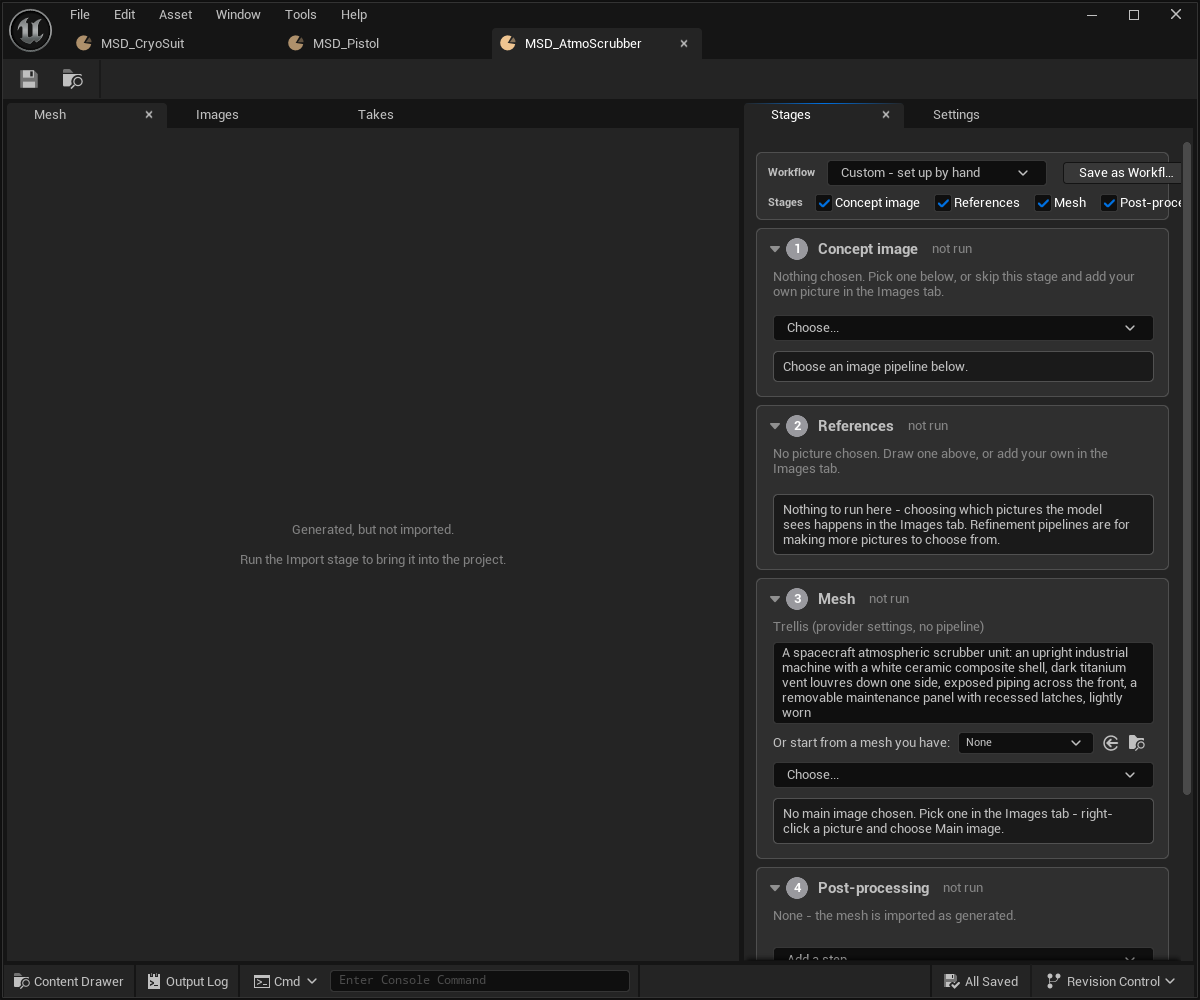
This route is early, and this definition is the evidence. Its last run ended with "Gave up after 900 seconds. The job may still be running." — the mesh runner's lease timing out rather than the model failing. Treat TRELLIS as experimental: it is genuinely free and genuinely reproducible, and it will also make you wait and sometimes give up.
The quality ladder is gated by VRAM
| Quality | Resolution | Measured |
|---|---|---|
| Draft | 512³ | — |
| Standard | 1024³ cascade | — |
| High | 1024³ cascade | 12.7 min cold on a 32 GB 5090; 24.7 min on 16 GB, by paging |
| Ultra | 1536³ | Never seen to finish below 80 GB |
A project-level ceiling caps it once (default High), so nobody picks Ultra on a laptop and waits.
Containers come up on demand
A stage that needs a runner takes a lease. The runner starts on the first lease — off the game thread, then polling health until it answers — and stops after the last is dropped: 900 s for the mesh runner, 300 s for the image runner.
It never stops a container it did not start, and by default leaves runners up when the editor closes.
A failure to get ready names one of five causes rather than saying "failed".
A separate image runner
Local reference-image generation runs in its own container on its own port.
The reason it is separate is measured: a High mesh that took 251 s with the card to itself did not finish in 45 minutes beside a resident image model.
It offers FLUX.2 klein 4B (Apache-2.0, default, about 15 s, 8.1 GB peak) and SDXL 1.0.
A helper script decides from measured VRAM whether the two runners may share the card or must take it in turn — a 9-second swap, measured on 16 GB.
Blackwell (RTX 50-series)
The runner probes attention kernels and pins one that works, avoiding the one
that breaks, and reports its compiled architectures on its health endpoint.
Set MESHFORGE_ATTENTION_KERNEL=off to restore default dispatch.
Meshy — hosted
Four pipelines:
- Standard (high quality) —
meshy-7.1by default, withmeshy-7marked superseded, plus older models.geometry_resolution(standard / 2k / 4k) replaces the deprecatedultra_mode; a saved definition carryingultra_modeis carried to 2k on load, and 4k is refused unless the model supports it with a single picture. Also image enhancement, auto-size, and a multi-image switch (main picture plus up to three views). - Smart lowpoly (T2) — target polycount 100–15,000.
- Image (nano-banana, GPT Image) — four models at 3 to 9 credits, with pose and aspect ratio.
- Retexture (a post step) — style from a description, one picture or several; 2K / 4K / 8K.
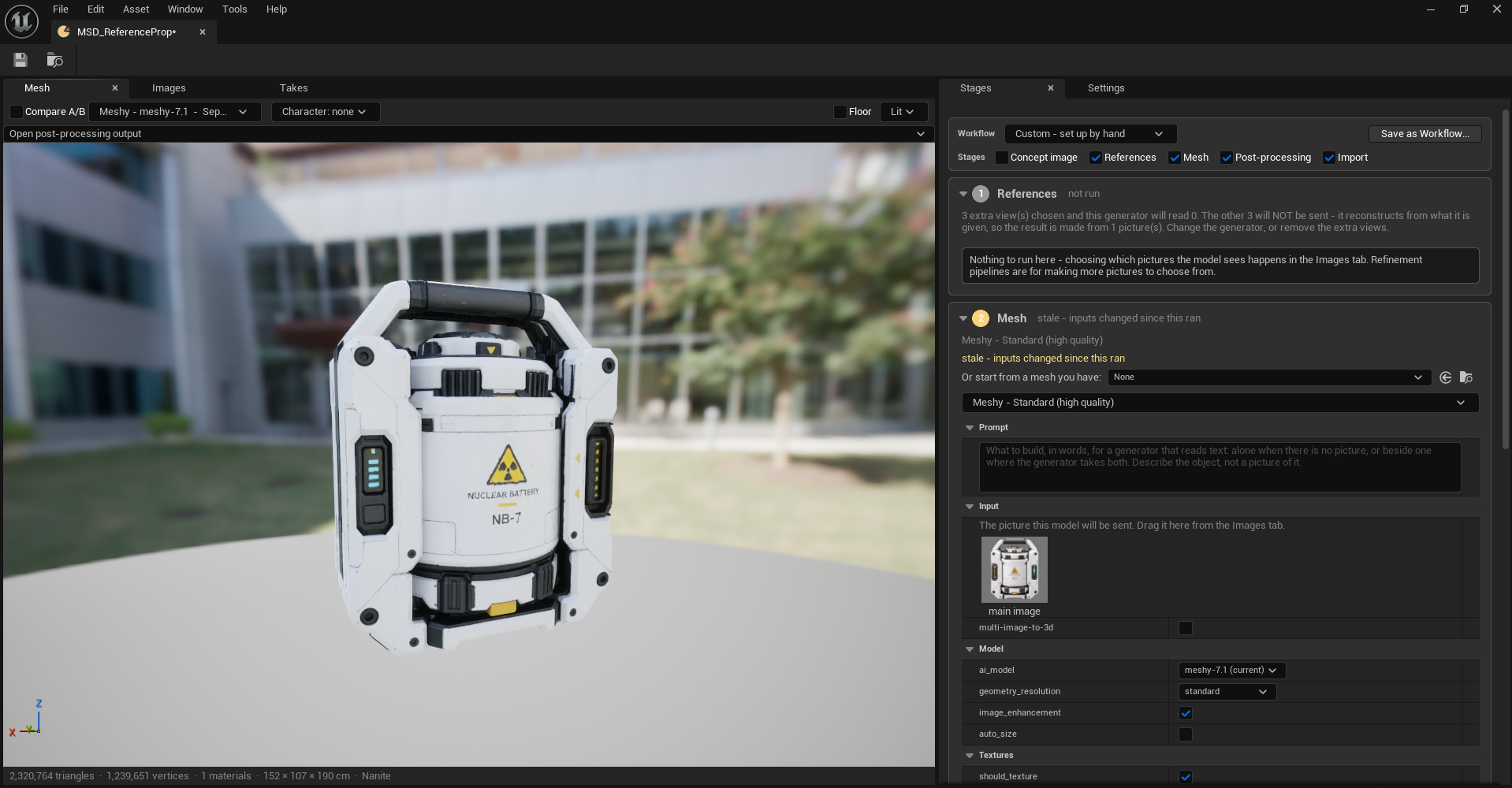
How many pictures a generator reads is a property of the generator, not of
the definition. Tripo's image stage says "it can read up to 3"; Meshy's
Standard pipeline reads the extras only when multi-image-to-3d is on, and
zero when it is off.
So choosing extra views in the Images tab is not the same as sending them. The References stage reconciles the two and names both numbers — "3 chosen and this generator will read 0" — with both ways out: change the generator, or remove the views.
Note also the Concept image stage unticked in that capture. This definition starts from a picture somebody already had, so the stage that draws one is switched off and does not appear in the list below.
A definition driven by quality alone, with no pipeline, keeps the older ladder on purpose: Draft and Standard go to smart topology, High and Ultra to the standard model.
Tripo — hosted
Five pipelines, on API v3:
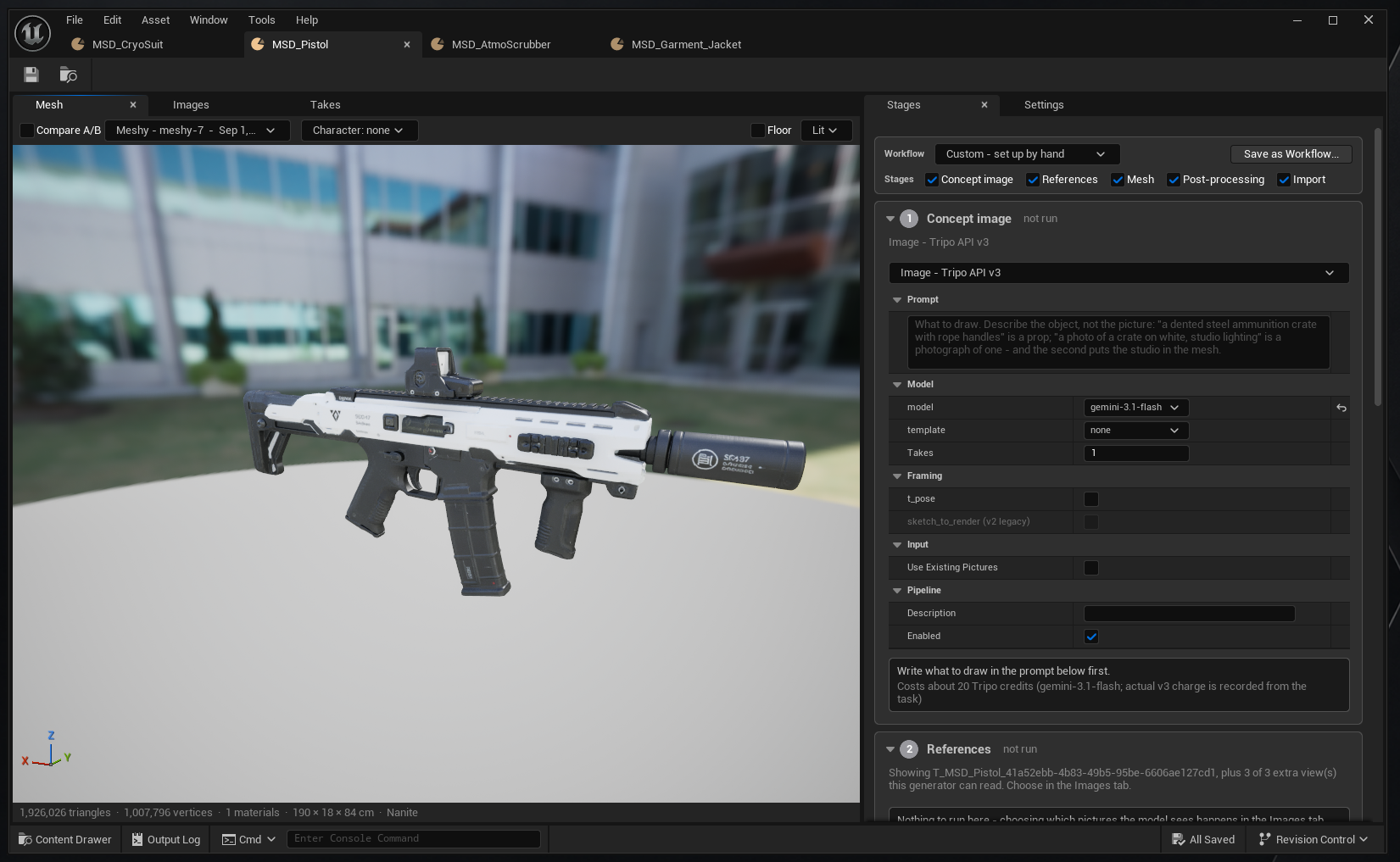
The prompt guidance in that field is worth stealing for your own prompts: describe the object, not the picture. "A dented steel ammunition crate with rope handles" is a prop; "a photo of a crate on white, studio lighting" is a photograph of one — and the second puts the studio in the mesh.
- Photoreal (H3) — geometry quality, smart low poly, face limit, quad (returns FBX), generate parts.
- Game ready (P2/P1) — face limit up to 50,000, quad.
- Image, multi-view (4 angles), and Retexture.
Both generators carry a type at the top of their settings:
| Type | What it sends |
|---|---|
image_to_model | The default, and what existing definitions keep. Shows the picture it sends |
multiview_to_model | Up to four views |
text_to_model | The prompt and no picture. 10 credits cheaper on H-series and P1, and greys the picture-only options |
Tripo's retexture works on any mesh, including ones Tripo did not make, by uploading it.
Test Connection reports balance
For both hosted vendors, Test Connection reports the remaining balance, not just whether the key is valid.
That is the difference between "your key works" and "you can afford the run you were about to start".
Choosing
Reach for TRELLIS when you want reproducibility, when the reference is confidential, when volume is high, or when you already own the GPU — and you have a reference image.
Reach for Meshy or Tripo for game topology generated rather than decimated, multi-image reconstruction, retexturing a mesh they did not make, or simply not owning a GPU.